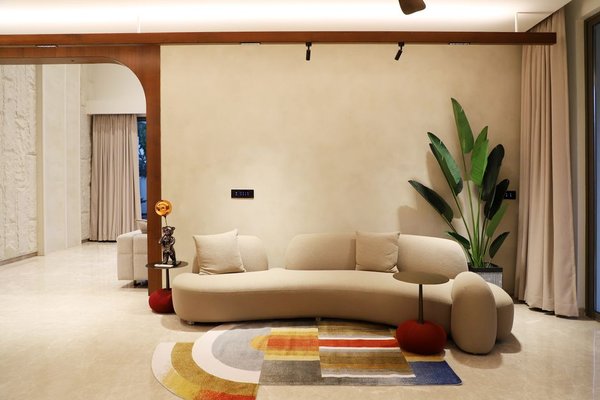
The curved sofa living room trend has moved beyond glossy show homes and into everyday British interiors. In 2026, the appeal is less about novelty and more about creating rooms that feel softer, calmer and more sociable. After years of boxy seating and strict straight lines, a rounded sofa introduces movement without making a space look overly designed.
It is also an effective statement piece. A curved sofa can define a seating area, improve the flow of an open-plan room and give a simple colour scheme a sculptural focus. The key is to treat it as the living room centrepiece, then build the rest of the scheme around its shape, scale and practical needs.
Why curved sofas suit 2026 interiors
The wider sculptural furniture trend is favouring organic silhouettes, rounded edges and pieces that look appealing from more than one angle. Curved sofas fit naturally into that shift. Their shape feels welcoming, while the absence of hard corners can make a room appear less rigid.
Curves can also change how people use a space. A straight sofa often directs everyone towards the television. A crescent or gently bowed design angles seats towards one another, helping conversation feel more natural. In an open-plan living room, its back can create a subtle boundary between lounging and dining zones without using a wall.
The strongest designs are becoming more refined: softly rounded backs, sloped arms and modular sections rather than exaggerated waves that sacrifice comfort. This makes the look feel like a considered long-term choice, not a short-lived novelty.
Choose the right curve for your room
Measure the full footprint
Curved sofas can occupy more floor area than their seat count suggests because the arc creates space behind or beside the frame. Mark the outline with masking tape and check that doors, drawers and walkways will still work comfortably.
In a compact UK living room, choose a shallow curve, rounded arms or a two-seat design with a softly bowed back. Larger rooms can handle a deeper crescent, a curved sectional or two complementary pieces arranged around a central table.
Consider floating the sofa
A curved sofa often looks best slightly away from the wall, where its outline can be seen clearly. In a bay window, curved wall or irregular open-plan layout, it can echo the architecture rather than fight against it.
When floating furniture is not practical, look for a sofa with a relatively straight back and a curved front edge. You will still gain the softer appearance while using the wall efficiently.
Balance soft shapes with structure
Repeat the curve sparingly
Good curved sofa styling usually includes one or two supporting shapes. A round coffee table, arched floor lamp or softly contoured rug can continue the visual rhythm. Repeating every item in a rounded form, however, can make the room feel themed.
Pair the sofa with a rectangular rug, straight shelving, a structured sideboard or angular artwork. These lines keep the scheme balanced and allow the sofa to remain the main statement.
Use the right scale
Because a curved sofa has strong visual presence, tiny accessories can look lost. Choose a coffee table that relates to the seating length and a rug large enough to sit beneath at least the front legs. A generously sized floor lamp can connect the sofa to the height of the room.
For statement sofa ideas that still feel liveable, keep nearby furniture visually lighter. Slim side tables and open-legged chairs preserve the sculptural outline, while bulky cabinets placed too close can flatten its impact.
Colours and fabrics for the 2026 look
Warm, nature-inspired shades work especially well with curved forms. Oatmeal, mushroom, clay, caramel, olive and muted rust emphasise softness without relying on cool grey. A creamy neutral offers flexibility, while chocolate, forest green or inky blue creates a stronger focal point.
Texture matters just as much as colour. Bouclé helped popularise rounded furniture, but chenille, velvet, brushed weaves and linen-look fabrics also enhance the shape. For a busy household, prioritise tightly woven, durable upholstery and removable or professionally cleanable covers. Pale looped fabrics may be less forgiving around pets, children and frequent spills.
Keep cushions edited rather than hiding the back. Two or three in mixed shapes are usually enough. A bolster can echo the curve, while one square cushion adds structure.
Lighting and accessories that finish the scheme
Use lighting to reveal the sofa’s shape. A floor lamp near one end creates an inviting reading spot, while a pendant above the coffee table defines the seating zone. Layered lighting is better than one harsh ceiling light because gentle shadows bring out the contours.
Artwork can provide useful contrast. One large rectangular piece behind the sofa gives it a clean visual frame. If the sofa floats, leave the back visible unless there is generous room for a slim console.
Natural materials help the room feel grounded. Timber, stone, wool, woven fibres and handmade ceramics prevent a smooth statement sofa from looking too polished. The goal is tactile and lived in, not showroom-perfect.
Common mistakes to avoid
The biggest mistake is buying for appearance before checking comfort. Sit on the sofa, note the seat depth and test whether the curve supports normal lounging. Some highly sculptural models provide less usable seating than expected.
Do not force the shape into a layout that really needs a conventional sectional. If your household requires maximum seating, storage or a chaise, a modular curved design may be more practical than a single crescent. Avoid surrounding it with several competing statement pieces too; the room needs one clear focus.
Frequently asked questions
Are curved sofas suitable for small living rooms?
Yes, when the curve is shallow and the overall depth is compact. Rounded arms or a gently bowed front can introduce the trend without consuming as much space as a dramatic crescent sofa.
Will the curved sofa trend date quickly?
Curved furniture has a long design history, so the basic silhouette is unlikely to disappear. Subtle curves, quality upholstery and a practical seat are safer long-term choices than extreme shapes.
What coffee table works with a curved sofa?
Round and oval tables follow the sofa’s flow, while a rectangular table creates contrast. Choose according to circulation space and ensure the surface is easy to reach from each seat.
Should a curved sofa sit against a wall?
It can, but many designs look more effective with space behind them. Floating the sofa highlights its shape and can help zone an open-plan room. In a smaller space, a flatter-backed model is easier to place against a wall.
A softer statement with lasting impact
The curved sofa living room trend works because it combines visual drama with a warmer way of arranging a room. Chosen carefully, it can improve circulation, encourage conversation and create a focal point without depending on bold pattern.
Let the sofa lead, repeat its curves sparingly and balance them with straight lines, practical fabrics and natural textures. The best result is a comfortable space where one sculptural piece gives the entire scheme confidence and flow.