Styling shelves sounds simple until you are standing in front of two alcoves beside a chimney breast, holding a vase in one hand and wondering why everything looks either sparse or crowded. In many UK living rooms, alcove shelving is part storage, part display and part architecture. The best result comes from balancing all three rather than filling every inch.
Start with the shelf, not the accessories
Look first at the width, height and depth of each shelf. Deep alcove shelves can handle books, framed art and larger ceramics, while narrow floating shelves usually need flatter, lighter pieces. A tall gap can take a vase or portrait-format artwork; a short one is better for stacked books, bowls and low objects.
If you have matching alcoves on both sides of a chimney breast, avoid making them identical. Perfect symmetry can feel stiff. Aim for visual balance instead: a tall vase on the lower left, for example, can be balanced by books and artwork of similar visual weight on the right.
Use a simple styling formula
Choose one anchor piece
Give each shelf a starting point: a framed print, ceramic vase, small lamp, sculptural object or substantial stack of books. The anchor should be large enough to register from across the room. Tiny accessories often encourage you to keep adding more.
Add contrast in height and shape
Next, add one or two items that differ in height, form or material. A rounded bowl beside upright books creates more interest than three objects of similar height. Mixing vertical and horizontal lines is one of the easiest shelf decor ideas to use without making every shelf look formulaic.
Finish with negative space
Empty shelf space is part of the arrangement. It separates groupings, makes favourite objects more noticeable and prevents a built-in unit from looking like storage overflow. When a shelf seems finished, step back and try removing one item.
Use the rule of three as a guide
Groups of three are useful because they naturally allow variation. Try one tall item, one medium item and one low item rather than three matching ornaments. Books, pottery and a framed photograph can feel more collected and personal than a matching set.
The rule is not compulsory. A single oversized vase can look better than three small pieces on a narrow floating shelf, while two substantial objects may be enough if their shapes complement each other. The goal is a clear composition, not a fixed object count.
Layer height and depth
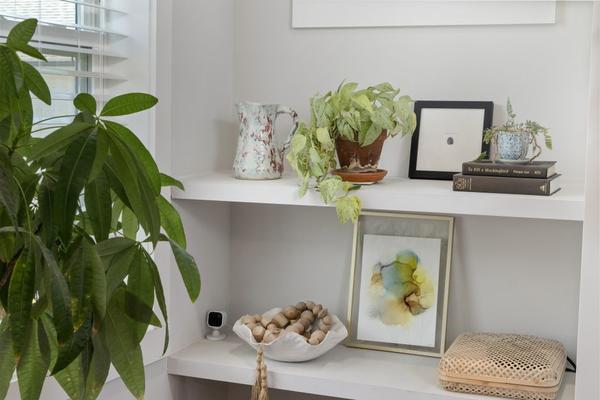
Flat rows of objects can make shelves look like shop displays. Create depth by overlapping pieces slightly and using the back as well as the front of the shelf. Lean a small framed print against the wall, place a short stack of books in front of it, then add a small bowl slightly off-centre.
This works especially well for bookshelf styling in deep alcoves. Books can also act as risers: place two or three horizontally beneath a candleholder, bowl or small sculpture to lift it to the right height.
Balance books with decorative objects
If the shelves need to store real books, let them do that job. Mix upright runs with smaller horizontal stacks, leaving occasional gaps for decorative pieces. Grouping some books by size or general colour can create calm, but an overly colour-coordinated library may feel artificial in a relaxed room.
Keep frequently used books within easy reach and reserve higher shelves for display. Heavier objects are generally better lower down. On floating shelves, always follow the manufacturer’s fixing and weight guidance.
Make chimney-breast alcoves work as one composition
Strong alcove shelving ideas respond to the fireplace and chimney breast rather than competing with them. Repeating one or two materials from elsewhere in the room helps: a brass frame that echoes a lamp, dark timber related to a coffee table, or stoneware that picks up a neutral wall colour.
Strong colours and large shapes attract attention first, so spread those elements across both sides instead of clustering them in one unit.
A practical example for two alcoves
Imagine two built-in units with four shelves on each side. On the upper left shelf, place a medium framed print slightly off-centre with a small ceramic object in front. On the upper right, use one taller vase and leave more empty space. On the middle shelves, mix upright books with horizontal stacks, but change their positions from side to side. Lower down, use baskets or boxes for less attractive everyday items.
The two sides should feel related without being copied. Repeat perhaps three things across both alcoves: the same wood tone, a similar ceramic finish and one recurring accent colour. Everything else can vary.
Common mistakes that create clutter
The biggest problem is often too many small objects. Several tiny frames, candles and ornaments create lots of visual edges, which the eye reads as clutter. Another mistake is spreading items evenly across the full width of every shelf. Grouping objects and leaving deliberate gaps usually looks more confident.
Avoid decorating each shelf as a separate project. Step back and judge the whole wall. Vary the pattern from shelf to shelf while keeping the overall palette connected.
Edit the final arrangement
Take a quick photo of the shelves on your phone. A photograph flattens the scene and makes imbalance easier to spot. Look for one side that feels heavy, several objects sitting at the same height, or a shelf with no breathing room. Move only one or two pieces at a time.
Natural next topics include choosing decorative accessories for a living room, styling a coffee table, and arranging wall art around a fireplace. Shelf styling works best when it connects with the other surfaces and focal points nearby.
Frequently asked questions
How do I style shelves without making them look cluttered?
Use fewer, larger pieces and group smaller objects instead of spreading them evenly. Vary height and shape, then leave visible gaps between groupings. If a shelf still feels busy, remove the smallest or least meaningful item first.
Should alcove shelves on both sides of a fireplace match?
No. Aim for balance through similar visual weight, repeated materials or a shared colour palette. Slight asymmetry usually feels more relaxed and interesting than mirrored arrangements.
What should I put on floating shelves?
Choose items that suit the shelf depth, such as small framed art, a few books and compact ceramics. Avoid overloading the shelf, and follow the stated weight limit and fixing instructions for the wall type.
How many items should go on each shelf?
There is no fixed number. One large object may be enough on a narrow shelf, while a wider alcove shelf can hold a grouped arrangement plus books. Judge the result by scale, balance and empty space rather than a target count.
Make the whole wall feel intentional
The best shelf styling rarely comes from buying more accessories. It comes from editing what you have, varying scale, layering pieces at different depths and allowing empty space to remain. In chimney-breast alcoves, treat both sides as one composition: related, balanced and useful, but not identical.